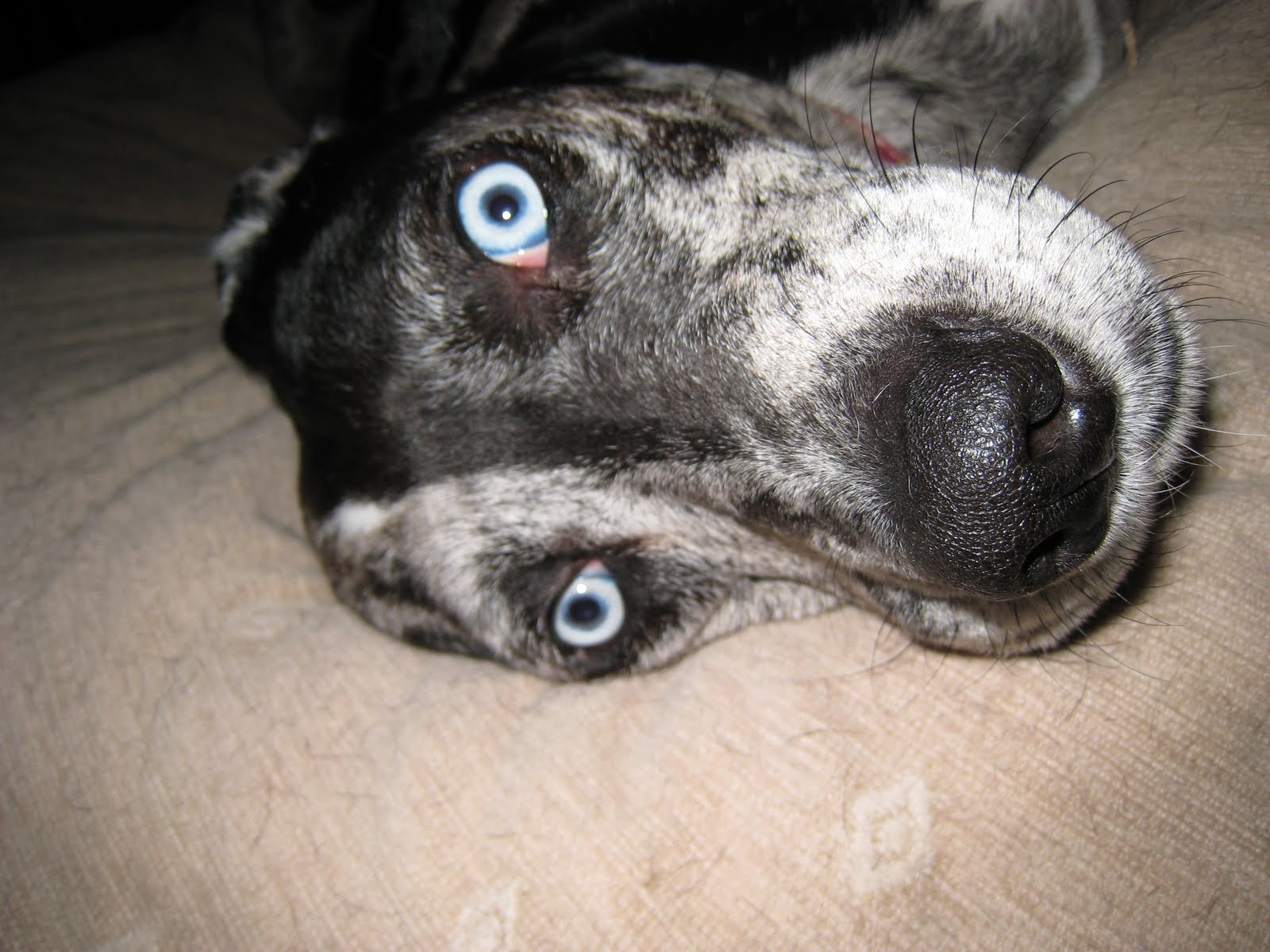
We brought Cloe a crate for her self and she refuses to stay in it, she sleeps with Reeko and is beside him all day and night.
Wednesday, April 14, 2010
Cloe
Tuesday, April 13, 2010
Dogs can suffer from season allergies too

Signs and symptoms that your dog may be suffering from seasonal allergies:
Nasal discharge
Ocular (eye) discharge
Difficulty breathing/wheezing
Itchy skin
Dry flaky skin
Red, swollen skin
Welts or hives
Biting or chewing at feet and paws
Swollen face
If you see any of these symptoms in your dog, call your vet right away. While true allergies can be difficult to accurately diagnose, it is important to talk to your vet at the first sign of these symptoms. He may recommend that you keep a daily log of your pet’s symptoms along with the corresponding weather for the day. He may also recommend a blood test to determine if there are other underlying conditions. If your dog is diagnosed with seasonal allergies, the treatment is usually simple. Your vet may prescribe an antihistamine, or, if the symptoms include secondary infections, he may also prescribe an antibiotic and a steroid.
Since we know how poorly we feel when we suffer from our seasonal allergies, we can imagine how our dogs must feel. It’s important to talk to your vet and get your dog on the appropriate treatment so that the two of you can enjoy the outdoors again.
Friday, April 9, 2010
Introducing Ms Farrah Fawcett
But Farrah didn't live up to her breed stereotype - she was quiet when I picked her up from Hopalong but quickly gave her trust to me and fell asleep in my lap on the long drive over the bay bridge. Me and my friend desperately scrambled to rename her - under the threat of my housemate suggesting the name 'Cordelia' - no, no - she was too young and sweet and flirty - Farrah Fawcett she was dubbed before we exited the highway.
I was warned that she would take a while to make friends - seperated from her two brothers - she'd been in the shelter by herself. However, Farrah it quickly became apparent - was a social butterfly! She was enthusiastic but courteous to everyone she met - even the downstairs cat! Everyone was captivated by her - and kept asking me if I was going to adopt. I admitted she was the cutest pup I'd ever met but was holding out in my heart. After all, if you adopt you can save one dog but fostering you can help many more!
However I dreamed of Farrah every night, tucked underneath my arm - together we adventured in a dream scape. Unconsciously I sorted through all the things in my life I could shift to make this work - to make her permanently mine. I tried to imagine not coming home to her, not sleeping next to her and the sadness I felt was not about not having a dog companion but about not having her. In a couple weeks I'd become so attached to her, all her funny noises and manic evening periods, the way she climbed up me in excitement when I got home, the feel of her head flopped over my arm to sleep.
When I took her in for her parvo shot I knew I wanted to adopt her - but I felt so nervous. I was a failure as a foster parent! A sucker on my first go! The Hopalong team made sure that I understood what a commitment this was, after all the difference between 2 weeks and 15ish years is a whole lot. But I knew I was in love and wanted Farrah to be mine forever.
A week later I signed the adoption papers and I'm so happy I did so. I'm so thankful to Hopalong for introducing me to Farrah - and I hope that other people will step in to become foster parents and maybe meet their own life companion!
Wednesday, March 31, 2010
Judy Bluesky

When I first saw her picture, she was called Skye. Her Piercing eyes were so often what drew people to her. I adopted her after losing my Betty, who was remarkable in her own ways as well. I felt that Betty was called out to me 'This little doggie needs you” and within a short amount of time, I would understand why this was true.
I changed Skye's name and she became Judy Bluesky. She actually picked the name herself. How? It was the one she chose to respond to. The 3rd time she acknowledged this name, it was a done deal.
Judy had had an awful start, the people before me kept her crated her entire first year and a half. They called her 'the dog' and she was viewed as 'too pretty to go outside'. And Judy was nearly completely damaged beyond repair. At three months in my care, she still cowered on walks, she still hid and ran at every little sound. Judy would cower and howl, often losing her bowels if anyone approached her too quickly. I accepted that I had taken on a responsibly beyond my control. I accepted that this little girl would spend her life in fear of it all, and that I would do my best to provide her with safety and comfort. I would protect her and care for her regardless of the fear.
And then the Miracle! Boo (a 75lbLabPitX) moved in next door. On our common deck, Judy saw Boo and she ran to him at full bolt. She got behind him and you could sense her complete surrender to him, 'You're a Dog, PLEASE, Protect me! The change in Judy was nearly overnight, in the next two weeks, she would learn what being pet was, she would learn not to fear the noises that Boo just didn't react to. She would learn from him to walk tall and to accept people. Her fears VANISHED, her Sweet Heart blossomed like a cactus flower that explodes as if it were a firecracker - only this flower NEVER wilted.Boo would eventually move away. But when his owner had two children close to each other, when the needs his family had dictated his need to work more than full time - Boo's 'all-days' with Tony turned into two 5 min walks a day. You cannot know Judy's Joy when he returned to live with us. He lives here still and was here for Judy's entire last year. Boo was Judy's Great Protector, her forever partner, her true love.
Judy had seizures and for the most part, we did very well controlling them with medication (Pheno). But once in a while she would still have one. This last Thanksgiving, Judy had a seizure that stopped her breathing - having watched net-vids about Canine resuscitation, I was prepared and was able to resuscitate her in under a minute. On Christmas Day 2009, Judy's last seizure had stopped her heart. Boo was as present as present can be, as he always was when Judy had a seizure. This time was a bit different. While I held her, he jumped up on the bed, he pushed his nose deep against her chest and he kept it there. He breathed deeply into her three times and without retracting. Then to my surprise, he threw back his head and howled in a tone I will never forget, the sound of it reverberated to my very core. This exclamation of Boo's unleashed the true depth of my grief.Dear Reader, you've been so patient. You’ve come along with me on this story that has so much Great Sadness in it. And now I tell you that I can not express to you in words how every moment of pain is countered by a Hundred Times the Absolute Joy I know from my experiences with Judy.Those first days with Boo around, when I saw her Heart Unfold are days I can never forget. They are Memories that flood my heart every time the thought of losing her returns. the way she Pranced, her little 'Girlie' steps. The way she cocked her head to the side, puzzled by the point I was trying to convey. The way she would sit on the sideline while Boo chased ball and that expression she would display, as if to say 'Sports are Stupid!' The way she would lay there on her side, offering me the gentle stroke of her paw and a tender little lick on the hand. The way I woke everyday with her laying there, looking into my face, waiting for just one eye to open and then, bursting into excitement, so happy that I was awake again. I miss these things, sometimes, every single moment. But I am Grateful that they ever happened at all. I am grateful for having known her, in ways I can never explain by language alone. The Great Challenge that Judy's circumstances had presented me with have become the Greatest Privilege I may ever know. This little Rescue, this little nearly discarded life opened a Chamber in my Heart that I didn't know was there.
Thursday, March 25, 2010
Litter Box Basics
Location, location, location – Cats like to eliminate in private. If the litter box is in a high traffic area of the house, the cat may not feel comfortable enough to go there.
To cover or not to cover, that is the question – many cats prefer covered litter boxes, they are about as private as it gets. But if your cat refuses to use a covered litter box, try removing the lid.
Size is definitely important – cats need to be able to completely turn around in the litter box. It is also important that the box has high sides if it is not covered to prevent accidents over the side. Higher sides also help reduce litter spray.
There are many options out there – clay, pine, corn, clumping, non-clumping the options are endless when it comes to litter types. Since cats don’t like change, picking one type of litter and sticking with it is the easiest way to ensure proper habits.
Keep it clean- this is the most important thing when house training cats. Cats don’t like to get their feet dirty and many will not even go into the litter box if it is too dirty. What is too dirty? That is up to the individual cat! Scooping at least once a day is mandatory, twice a day is preferred by most cats (and it helps reduce the smell too!)
Sharing may not be an option here – The rule of thumb is to have one more litter box than you have cats. But in a multi cat household, that could mean a lot of litter boxes. However, sometimes there are cases when one cat will not allow another to use “their” box. And if there are not any other options, sometimes the poor cat has no choice. This is one of those cases where it is better to be safe than sorry – having too many litter boxes is better than having to clean up accidents.
Talk to your vet – if your cat begins to urinate inappropriately you should call you vet and talk to him about a possible infection. If an infection has been ruled out, and these tricks don’t work, ask for a referral to a behaviorist.
Saturday, March 13, 2010
Why Is My Dog Fat And What can I Do About It?

Well, maybe not genetic, but definitely medical. And while it may seem that certain breeds (labs, beagles) put on weight faster than other (huskies, boxers) the truth is that all dogs are susceptible to weight gain. But there are certain medical conditions that contribute to rapid weight gain. The most common of these is hypothyroidism. Hypothyroidism causes the dog’s thyroid to produce less hormone which, in turn causes a lower metabolic rate, which means that your dog needs less energy (ie: food). Another possible medical condition causing your dog’s girth could be Cushing’s disease. Cushing’s disease causes a rise in a certain hormone that increases your pet’s appetite and increases the deposition of fat. Talk to your vet before beginning a diet and exercise routine with your dog to rule out any medical condition. Dogs with certain medical conditions will not loose weight without proper medication.
Too much food
Before the 1950s, and the invention of commercialized dog food, dogs used to eat what we ate – a little bit of protein, a little bit of veggies, and a little bit of starch. Now that most of our pets eat kibble, we don’t know how much of what they are eating. Many people buy food based on ads they see on TV or what their friends recommend without thinking about the caloric needs of their pets. Some of the more popular brands are higher in starch and lower in protein – ok for some active breeds that could use the extra sugars, but maybe not so great for the couch potato sitting at your feet. Just as it is important for us to read our food labels, it is also important to read the labels on the food that we feed our pets. Not only will they tell us what is in the food we feed, but it will also tell us how much to feed based on the ideal weight of our pets.
Couch Potatoes
As we spend more time sitting in front of the TV so do our pets. Dogs and cats used to have to hunt and scavenge for their food, now they have us perfectly trained to bring them their food in nice big bowls. Since the necessity for activity has decreased, so has their desire to run around. It is up to us to exercise our dogs properly. If your dog is friendly and social you might want to try the dog park. If your dog doesn’t really like to play with other dogs, but is still tolerant and is well trained, you can try a local off leash beach or a hike in the woods. If your dog isn’t trustworthy around other dogs, and/or isn’t trustworthy off leash, a nice long walk around the neighborhood should do the trick. Remember to start off slowly and gradually increase the intensity of the exercise so that your furry friend doesn’t injure himself.
Sagging Bellies and Sagging Knees
This one is multifaceted because as our pets continue to age their lifestyle changes make it more likely that they will gain weight. Few people think to change the food they feed their senior pet. Many still feed the same food in the same amount that they fed their dog when he was a growing puppy. Also, senior pets are less active then they were when they were young. It is important to talk to your vet about the dietary needs of your senior pet. Many dogs need less food then they did when they were younger.
One thing its not: Sterilization
Many people blame their pet’s weight on sterilization saying that their pet was never overweight before it was “fixed”. While that may be true, there are many reasons why your pet might not have been overweight before. The first, and most often over looked is that many people get their pets fixed right around the time that they stop growing. People continue to feed them like a puppy when they no longer need it. It is true, however, that intact pets have hormones that help them stay slimmer. Estrogen (female sex hormones) can decrease appetite and androgen (male sex hormone) can stimulate roaming behaviors (ie: more physical activity). Once a pet is sterilized, their metabolic rate will probably lower some and their desire to roam will also decrease, therefore their caloric need will drop. It is up to the owners to adjust their feeding to the proper amount needed for their dog after surgery. It is not the surgery itself, but a combination of factors and a lack of understanding by the owner that contribute to weight gain sometimes seen after a pet has been sterilized.
Obesity is quickly becoming one of the largest issues facing our pets today. And is it any surprise that as our waist lines grow, so do our pets. Most pets become obese the same way that people do – they eat too much and exercise too little. And the complications they face as they grow rounder are the same that we as humans face: diabetes, respiratory difficulty, higher risk during surgery, joint pain, and shorter life span. It is important that you get your pet’s weight under control so that you can live long happy lives together.
Friday, February 19, 2010
What Should You Do If You Find An Abandoned Kitten
If you find a kitten that has truly been abandoned, the first thing that you should do is to get him somewhere warm and safe. If you cannot care for him yourself, you can call a local animal rescue and see if they have room to take him in. Rescues get many calls every day asking for help and they may not have the resources to take in every orphaned kitten. If rescues cannot take him in, then your next option would be your local animal control. Do not assume that they will be automatically euthanized upon intake. Many animal control agencies work very closely with rescues that have resources for orphaned kitties. Some animal control agencies might have a lactating mother cat that might be willing to take on an additional kitten. Never leave an orphaned kitten to die outside hungry and cold.
If you can care for the kitten yourself you will need to create a warm, cozy place that is away from other pets. He will also need a litter box with non-clumping litter. The kitten will also need age appropriate food. If the kitten is very young, it will need to be bottle fed with KMR (kitten meal replacement) – sold at most pet stores, along with bottles. Never give kittens cow’s milk. If the kitten does need to be bottle fed, he will need to eat every 2-4 hours around the clock. If the kitten is a bit older and can lap from a dish, you can mix KMR and kitten wet food and make a very soupy mixture. Kittens at this age will still need to eat every 4 hours. Kittens between 6-8 weeks old can usually eat dry kitten food with wet food being weaned off gradually.
Once the kitten is around eight weeks old, he can be placed up for adoption. Before that happens, make sure that you get him neutered so that you aren’t faced with the same problem all over again next year! But, since different vets recommend surgery at different ages/weights, make sure that you follow their advice and have them fixed at the appropriate time. Many veterinarians will offer low cost neuters for rescue kitties. If you can’t find a vet who offers low cost surgery options, call your local animal control and see if have services for low cost spay/neuter.


